
Concrete Repair vs. Replacement in Grapevine, TX: Which Do You Need?
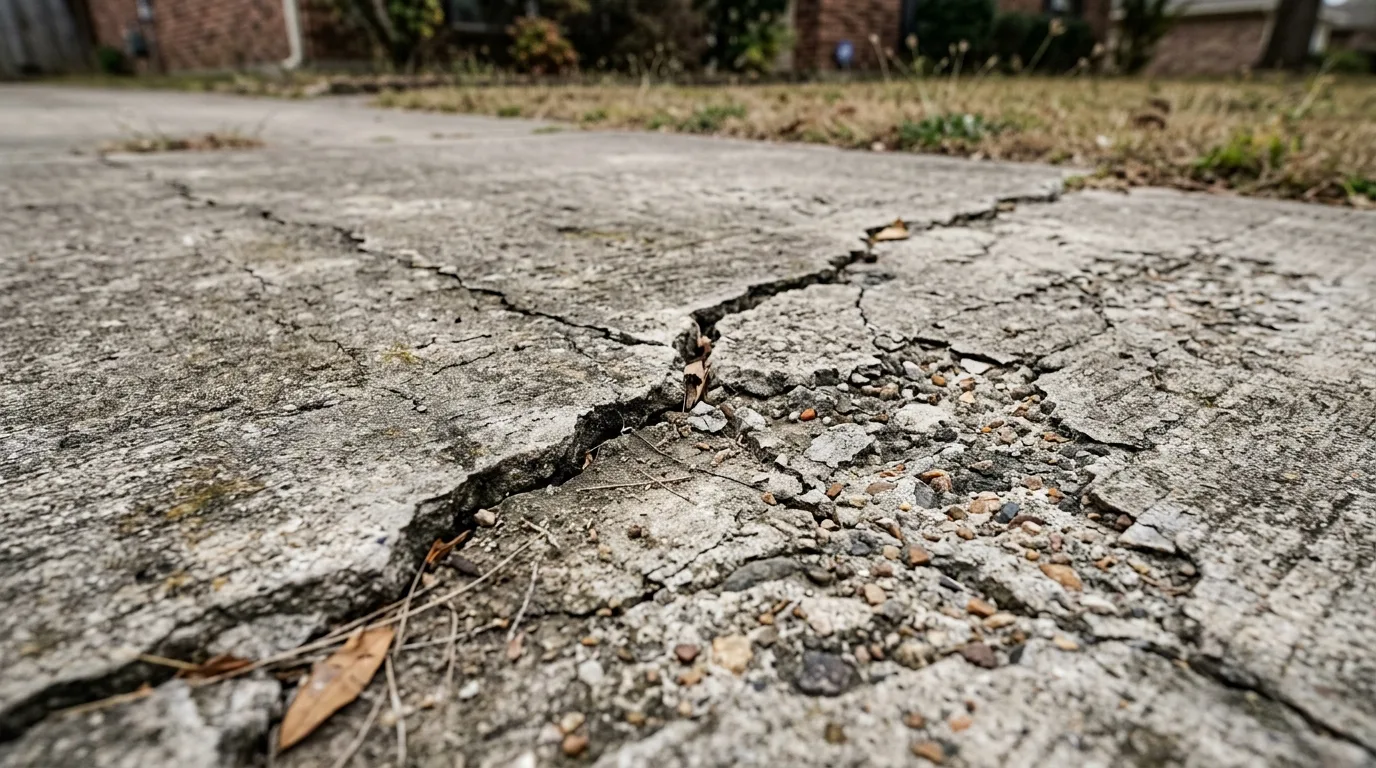
Grapevine homeowners face this question regularly: the driveway or patio has clear damage — cracks, settled sections, surface spalling — and the practical question is whether repair can address it cost-effectively or whether replacement is the more honest answer. The decision matters financially. Repair costs range from a few hundred dollars for crack filling to $2,000–$3,000 for full concrete resurfacing. Replacement ranges from $2,000 to $10,000+ for a full driveway. Paying for repairs that fail in 2–3 years because the underlying condition warranted replacement is money lost.
This guide provides an honest, decision-tree framework for concrete repair vs. replacement in Grapevine — organized by damage type so you can match your situation to the right answer.
Free Repair vs. Replacement Assessment in Grapevine
Grapevine Concrete Company provides honest assessments — we'll tell you which actually makes sense for your slab. Call (888) 376-0955.
The Core Decision Framework
Repair is the right answer when:
- The damage is isolated (affecting less than 25–30% of the slab)
- The structural sub-base is intact (no voids, no differential settlement over 1 inch)
- The concrete itself has not failed through its full depth in the damaged area
- The slab is less than 20–25 years old and is otherwise in good condition
Replacement is the right answer when:
- Damage affects 30%+ of the slab area
- The sub-base has failed (settled sections, voids, repeated heaving)
- The concrete has full-depth fractures through multiple adjacent sections
- Previous repairs on the same slab have failed
- The slab is 30+ years old with multiple areas of deterioration
By Damage Type: Concrete Repair
Surface Cracks (Hairline to 1/4 Inch Wide)
Verdict: Repair
Hairline cracks and narrow cracks up to 1/4 inch that haven’t displaced vertically (both sides of the crack are still flush) are good candidates for crack filling. Polyurethane or epoxy crack filler seals the crack against water infiltration, which in Grapevine’s freeze cycle prevents the water-freeze-expand cycle from widening the crack further.
Crack filling is the least expensive intervention ($150–$400 for typical residential crack filling) and appropriate when the crack is isolated and the rest of the slab is in good condition.
Surface Spalling (Shallow)
Verdict: Repair with Resurfacing
Surface spalling — where the top layer of concrete peels away in flakes, exposing the coarse aggregate beneath — that’s less than 1 inch deep across a contained area can be addressed with concrete resurfacing. A bonded overlay applied to the cleaned surface restores the appearance and texture. Resurfacing costs $3–$6/SF and is appropriate when the underlying concrete is structurally sound and the spalling hasn’t penetrated to the rebar depth.
Isolated Low Spots / Minor Settling
Verdict: Repair with Mudjacking
A concrete slab section that has settled 1/2 to 1 inch lower than adjacent sections — creating a trip hazard or drainage problem — can often be lifted with mudjacking (slab lifting). Mudjacking injects a grout slurry under the settled slab section through small drilled holes, lifting it back to grade. This repair works when the slab itself is intact and the settlement is caused by a void or soft spot in the sub-base rather than clay heave.
Mudjacking costs $3–$6/SF on the settled section — significantly less than removal and replacement. It’s appropriate when the settled slab is otherwise in good condition and the cause of settlement can be addressed through injection.
Concrete Repair or Replacement Quote in Grapevine
We assess every slab condition honestly. Call (888) 376-0955 for a free evaluation.
By Damage Type: Concrete Replacement
Full-Depth Cracks With Vertical Displacement
Verdict: Replacement
When adjacent sections of a cracked slab have moved vertically — one section is higher or lower than the other at the crack line — the structural integrity of the slab at that joint has failed. Crack filling a slab with vertical displacement doesn’t address the root cause (sub-base failure or clay movement), and the sections will continue to move independently. Replacement with proper base preparation is the correct answer.
Widespread Cracking Across the Slab
Verdict: Replacement
A slab with a “map cracking” or “alligator cracking” pattern — where cracks form a network across a large portion of the surface — has lost structural integrity across the affected area. Individual crack filling can’t address this pattern because the underlying concrete has failed as a unified slab. Removal and replacement is the appropriate response.
Recurring Patch Failure
Verdict: Replacement
If you’ve patched the same area two or more times and the patch has failed each time, the underlying condition (sub-base void, active clay movement, drainage failure) is not being addressed by surface repair. Further repairs will follow the same pattern. Replacement with correction of the underlying condition is the only path to a lasting result.
Age-Based Deterioration (30+ Years)
Verdict: Replacement
Concrete installed in Grapevine in the 1980s and 1990s — the period when many current homeowners’ homes were built — was often installed with minimal base preparation for the clay soil conditions. After 30+ years of cumulative clay movement and weather cycling, the cost of ongoing repair typically approaches or exceeds the cost of replacement within a few years. Full replacement with current base standards extends service life by 30–50 years.
A Note on “Concrete Resurfacing” Claims
Concrete resurfacing overlays are widely marketed as a cosmetic fix that “makes old concrete look new.” A bonded overlay addresses surface appearance effectively when the underlying concrete is structurally sound. It does not address sub-base issues, full-depth cracks, or differential settlement. A resurfaced slab with active sub-base problems will show cracks through the new overlay surface within 1–3 years.
Before investing in resurfacing, assess the underlying slab condition honestly. If the slab has full-depth cracks or active settlement, resurfacing is a cosmetic delay — not a repair.
Frequently Asked Questions
How do I tell if my Grapevine concrete needs repair or replacement without an expert?
The clearest self-assessment is the vertical displacement test: run your hand along each crack in the slab. If both sides of the crack are flush (no vertical step), repair is likely appropriate. If one side is measurably higher than the other, or if you can see the crack from several feet away as a raised edge, replacement is more likely. Also: how much of the slab is affected? Under 25%? Repair. Over 50%? Replacement.
Is it worth repairing concrete in Grapevine if I plan to sell the house in 2–3 years?
For cosmetic surface issues visible from the street (surface spalling, narrow surface cracks), repair improves curb appeal at relatively low cost and is worth doing before listing. For deeper structural issues (differential settlement, widespread cracking), buyers’ home inspectors will flag them regardless of cosmetic patch work — addressing the underlying issue honestly, or pricing the home accordingly, is more practical than cosmetic patching of structural problems.
How long do concrete repairs last in Grapevine, TX?
Properly executed crack filling on a stable slab can last 5–10+ years before requiring re-treatment. Mudjacking repairs on stabilized sub-base last 8–15 years. Concrete resurfacing on a structurally sound slab lasts 10–15 years with proper sealing. Repairs on actively moving sub-base fail in 1–3 years regardless of repair quality.
Honest Concrete Repair and Replacement in Grapevine
We tell you which option actually makes sense for your slab condition — no upselling. Call Grapevine Concrete Company at (888) 376-0955.
Related: