
Concrete vs. Asphalt Driveway: Which Is Better for Grapevine, TX?
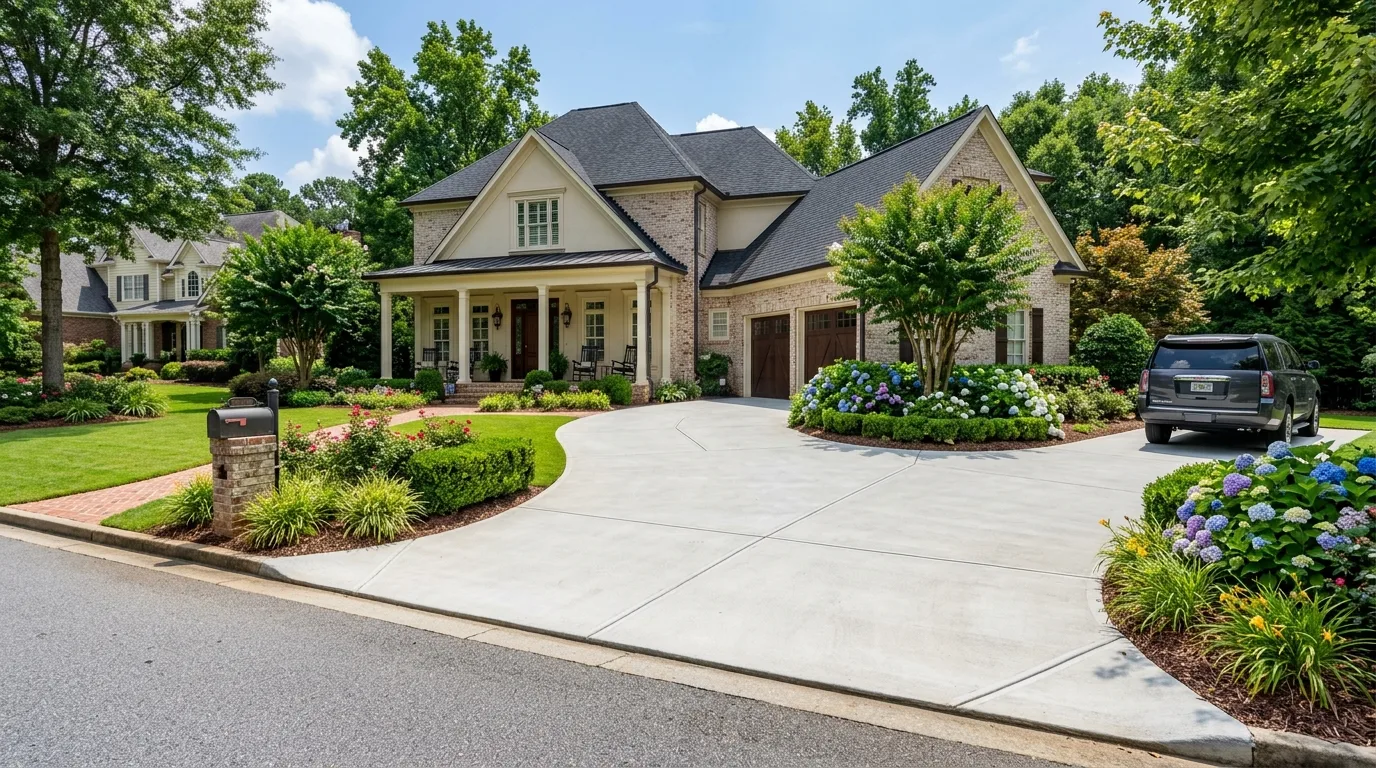
If you’re replacing a driveway in Grapevine and evaluating material options, concrete versus asphalt is often the first comparison homeowners make. Both are commonly installed in the DFW Metroplex, both handle vehicle loads effectively, and both cost significantly less than pavers. But in Grapevine’s specific conditions — Tarrant County’s expansive clay soil and the temperature range from 96°F summer highs to occasional hard freezes — the two materials perform very differently over their lifespans. This guide compares them directly on the factors that matter for a Grapevine homeowner making a long-term decision.
Concrete Driveway Estimate in Grapevine
Grapevine Concrete Company provides free written estimates for driveway installation and replacement. Call (888) 376-0955.
Upfront Cost
Asphalt wins on upfront installation cost. Asphalt driveways in the Grapevine area typically run $3–$5/SF installed, compared to concrete at $5–$10/SF. For a standard two-car driveway of 400–600 SF, the difference is roughly $800–$3,000 in upfront cost in asphalt’s favor.
Concrete: $2,000–$6,000 for a 400–600 SF broom-finish driveway
Asphalt: $1,200–$3,000 for the same driveway
The upfront cost difference is real — but it’s the beginning of the cost comparison, not the conclusion.
Long-Term Cost and Maintenance
Asphalt requires periodic maintenance that concrete does not. Asphalt driveways need to be sealed every 3–5 years to protect against oil softening and UV oxidation. In Grapevine’s summer heat — average highs above 88°F from June through August — unprotected asphalt softens faster than in moderate climates, accelerating degradation. Asphalt sealing costs $0.15–$0.25/SF per treatment, adding $60–$150 every few years to the ongoing cost.
Asphalt’s expected lifespan is 20–30 years with proper sealing and maintenance. Concrete’s expected lifespan in Grapevine is 30–50 years with periodic sealing every 5–7 years at a lower cost. The lifetime cost picture, accounting for shorter lifespan and higher maintenance frequency, often brings asphalt’s real cost closer to concrete’s — and occasionally past it on larger projects.
Concrete: periodic penetrating sealer ($0.10–$0.15/SF every 5–7 years); expected 30–50 year lifespan
Asphalt: surface seal every 3–5 years; occasional crack filling; possible overlay at 15–20 years; expected 20–30 year lifespan
Performance on Grapevine’s Expansive Clay Soil
This is where the comparison tips firmly toward concrete for most Grapevine homeowners.
Tarrant County’s expansive clay soil undergoes significant volume changes with moisture variations — expanding in wet conditions, contracting during drought. Both concrete and asphalt are affected by clay soil movement, but they respond differently.
Asphalt is more flexible and tolerates minor movement without cracking. However, that same flexibility means it can deform permanently — you can see ruts and waves in asphalt driveways where repeated clay movement has displaced the surface. Asphalt that has rutted or waved cannot be reversed; it requires cold planing or full replacement.
Concrete is rigid and doesn’t rut or wave. When subjected to differential clay movement, concrete typically cracks rather than deforming. But with proper base preparation — 4–6 inches of compacted gravel between the clay and the concrete — the clay movement is attenuated before it reaches the slab. Well-installed concrete on adequate base shows significantly fewer movement-related defects than asphalt on the same soil.
The conclusion: in Grapevine’s clay soil, concrete’s rigid failure mode (cracking that can be repaired) is generally more manageable than asphalt’s plastic failure mode (rutting and waving that requires full resurfacing). Concrete with proper base prep is the better-performing material on expansive clay.
Heat Performance
Asphalt absorbs more heat than concrete — dark asphalt surfaces reach surface temperatures of 150°F+ during Grapevine’s summer. At those temperatures, asphalt softens, making it vulnerable to damage from vehicle turning and parked heavy vehicles. Power steering turns on a soft asphalt surface during a July afternoon can leave marks.
Concrete reflects more solar heat and doesn’t soften in summer conditions. Lighter concrete surfaces are also more comfortable for pets and bare feet during summer, and the reduced heat absorption has a modest effect on adjacent home cooling loads.
Is Concrete the Right Call for Your Grapevine Driveway?
We provide honest estimates for both new installation and replacement. Call (888) 376-0955.
Appearance and Curb Appeal
Concrete offers more versatility in appearance. Standard broom-finish concrete provides a clean, uniform surface. Stamped concrete can replicate stone, slate, or brick patterns. Exposed aggregate creates a distinctive textured look. These options don’t exist with asphalt — asphalt is uniformly black when new, fading to gray as it oxidizes, with no decorative options.
For Grapevine homeowners in neighborhoods like Stone Bridge Oaks with active HOAs and high curb-appeal standards, concrete’s decorative options are a significant differentiator.
Repairability
Both materials are repairable, but differently:
Concrete repairs are visible — patched areas typically don’t match the color and texture of the surrounding slab exactly. This makes concrete harder to repair invisibly after cracking. Mudjacking can lift settled sections. Major structural repairs require saw-cutting and section replacement.
Asphalt repairs blend better — new asphalt patch can be hot-applied and rolled to match the surrounding surface reasonably well once it weathers. Asphalt overlays over deteriorating base extend the surface life without full removal.
For homeowners who prioritize invisible repairability, asphalt has an edge. For homeowners who prioritize long-term performance with less frequent intervention, concrete wins.
Side-by-Side Summary
| Factor | Concrete | Asphalt |
|---|---|---|
| Upfront cost | Higher ($5–$10/SF) | Lower ($3–$5/SF) |
| Lifespan (Grapevine conditions) | 30–50 years | 20–30 years |
| Maintenance frequency | Low (seal every 5–7 yrs) | Higher (seal every 3–5 yrs) |
| Heat performance | Excellent (no softening) | Poor (softens 150°F+) |
| Clay soil performance | Excellent with base prep | Good but prone to rutting |
| Decorative options | Many (stamped, aggregate) | None |
| Repair visibility | Visible patches | Blends well |
| Best for Grapevine | Long-term investment | Budget-constrained projects |
Frequently Asked Questions
In Grapevine, TX, which driveway material do most contractors recommend?
Most experienced DFW-area concrete contractors recommend concrete for residential driveways in Grapevine — primarily because of how it performs on clay soil and in summer heat over a 30–50 year lifespan. Asphalt is a viable option for budget-constrained projects where the lower upfront cost is the priority.
Can I switch from asphalt to concrete when my driveway needs replacement?
Yes — when an asphalt driveway reaches end of life, replacing it with concrete is straightforward. The asphalt is removed, sub-base is prepared to concrete installation standards, and the new concrete driveway is poured. We handle full asphalt-to-concrete replacements regularly in Grapevine and the surrounding Tarrant County area.
Does concrete or asphalt hold up better to freeze-thaw in Grapevine?
Both materials can be affected by freeze-thaw cycling, but North Texas has fewer freeze-thaw cycles per year than northern climates — Grapevine averages fewer than 20 freeze cycles per year. At that frequency, properly installed concrete shows minimal freeze-thaw degradation. Asphalt is somewhat more freeze-thaw tolerant due to its flexibility, but this is a less significant factor in Grapevine than the heat and clay soil considerations.
Concrete Driveways for Grapevine Homeowners
Grapevine Concrete Company installs concrete driveways built for Tarrant County's clay soil and North Texas heat. Call (888) 376-0955 for a free written estimate.
Related: