
Grapevine's Expansive Clay Soil: Why It Matters for Concrete
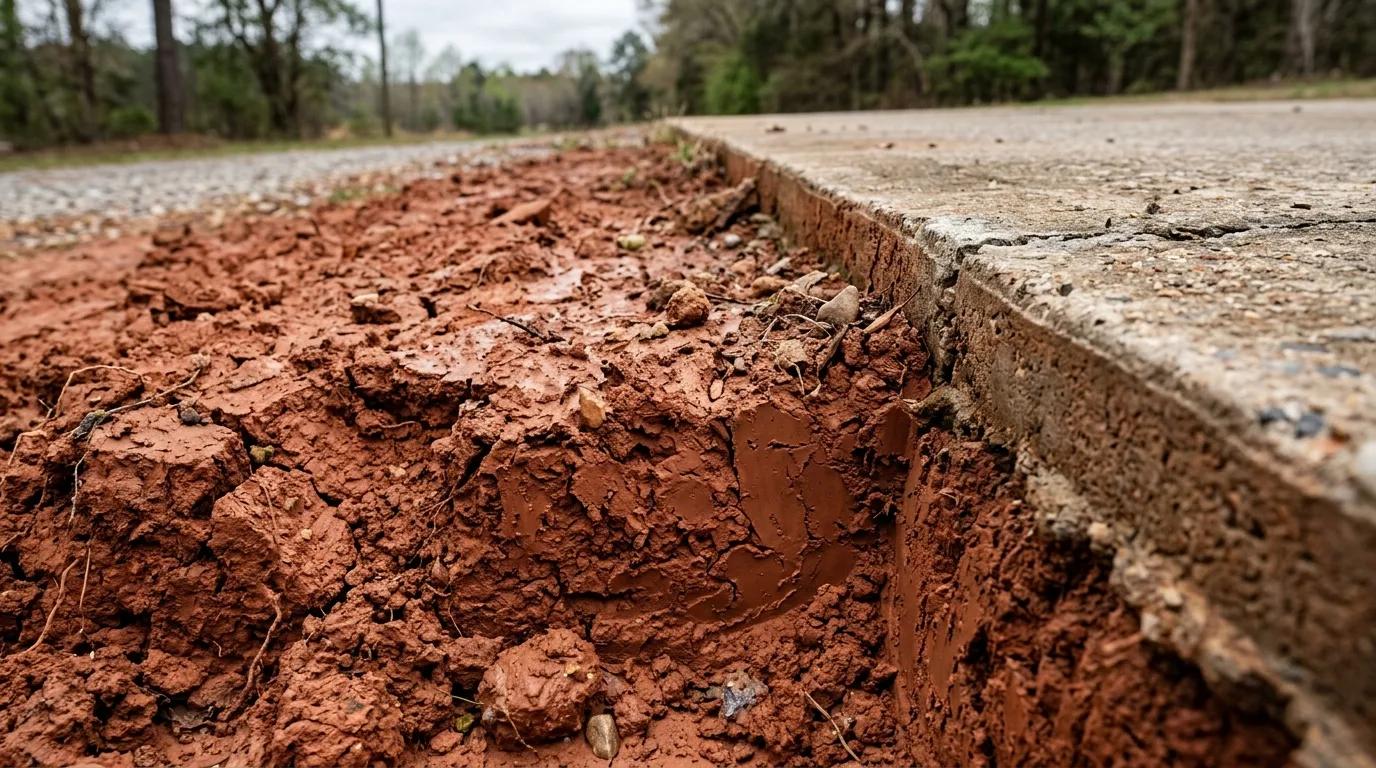
Walk through Grapevine’s older neighborhoods and you’ll often spot the same patterns: diagonal cracks running from door corners, stair-step cracks in brick veneer, and driveways that seem to have heaved or settled without any obvious cause. These aren’t isolated incidents or contractor failures — they’re the consistent result of Grapevine’s ground conditions working against structures that weren’t built to account for them. The City of Grapevine formally classifies its soil as “extremely expansive” in its own building code, a designation that carries real engineering consequences for every concrete slab, foundation, and flatwork installation in the area.
In this post, we cover what expansive clay soil actually is, how it affects concrete slabs and foundations in Grapevine, what the City of Grapevine’s code requires, and what proper construction practices protect against it.
Building or Repairing Concrete in Grapevine?
Grapevine Concrete Company engineers every project for local clay soil conditions. Call (888) 376-0955 for a free estimate.
What Is Expansive Clay Soil?
Expansive clay soil is a type of fine-grained soil that swells in volume when it absorbs water and shrinks when it dries out. The active mineral in most Texas expansive clays is montmorillonite — a plate-like particle that stacks and separates with moisture changes, generating significant force as it does so. Tarrant County’s clay can expand to 150% or more of its dry volume during wet periods.
In the Grapevine area, this means that the soil beneath every concrete slab, foundation, and flatwork installation is in constant seasonal motion. During North Texas’s wet winters and spring rains, the clay swells upward against the underside of slabs. During summer drought — with average highs above 96°F in August — the clay pulls back and contracts, leaving voids beneath concrete that allow sections to settle unevenly. This cycle repeats every year, and its effects accumulate over time in concrete that wasn’t designed to handle it.
How Expansive Clay Affects Concrete Slabs in Grapevine
Concrete slabs installed directly on expansive clay without a protective gravel buffer behave like a raft on a moving ocean. During wet cycles, the clay pushes up on the slab edges and perimeter — the zones with the most surface area in contact with soil. During dry cycles, the center of a large slab can remain supported by residual moisture while the perimeter settles, creating the classic “dish” settlement pattern where center sections sit higher than the edges.
For homeowners in neighborhoods like Dove Creek and Stone Bridge Oaks, this soil behavior explains why driveways and patios that looked fine for five years suddenly develop multiple cracks in the sixth or seventh year. The cumulative deformation finally exceeds the concrete slab’s ability to flex, and the damage becomes visible.
The solution — a 4–6 inch compacted gravel base between the clay and the concrete slab — creates a drainage layer and a cushioning zone that buffers the soil’s movement before it reaches the concrete. Rebar holds the slab together as a unit if the soil beneath shifts unevenly, preventing random fracturing into independent sections. These two elements together are the standard for concrete installation in Grapevine’s conditions.
What Grapevine’s Building Code Requires
Grapevine’s building code addresses the soil conditions directly. The relevant language: “Due to the extremely expansive soils in this area, foundations (new and addition) must be designed by a State of Texas Registered Professional Engineer. The only exception is for residential additions of 400 square feet or less where it can be verified that the original foundation was not engineered.”
This requirement exists because expansive clay soil generates enough upward force during wet cycles to crack standard slab designs that would perform adequately in stable soil. An engineered foundation design accounts for the soil’s expected movement range and specifies rebar schedules, beam depths, and stiffening elements that allow the foundation to move as a unit rather than cracking differentially.
The same principle applies to other concrete slabs, even when they don’t legally require engineering: the concrete slab over Grapevine’s clay benefits from the same design philosophy — a gravel buffer, proper reinforcement, and expansion joint placement that accommodates seasonal movement without surface damage.
Questions About Concrete Installation on Grapevine's Clay Soil?
We'll explain exactly what your project requires for long-term performance. Call (888) 376-0955 for a free assessment.
How Clay Soil Interacts with Grapevine’s Climate
The expansive clay problem is amplified by Grapevine’s climate extremes. Winter rainfall and spring wet seasons saturate the clay, producing maximum swell. Summer drought then pulls moisture out rapidly — the transition from saturated to severely dry can happen in 4–8 weeks in a North Texas summer, producing significant differential settlement in slabs that sat flat for months.
Properties in the Lakeview Estates and Meadowmere Park neighborhoods near Lake Grapevine experience an additional moisture dynamic: proximity to the 8,000-acre lake maintains higher ambient soil moisture on one side of a property relative to the other, which can cause slabs to tilt over time as one side settles more than the other. This is not a reason to avoid lake-area concrete work — it’s a reason to account for it in drainage design and base preparation during installation.
Trees planted near foundations in Grapevine are a common secondary cause of differential settlement. Tree roots extract moisture from the clay directly below the foundation, causing localized shrinkage on one side of a home while the rest of the foundation sits on wetter soil. Many foundation repair calls in the Historic Downtown Grapevine area and older neighborhoods trace back to mature trees planted within 10 feet of the foundation.
What This Means for Your Concrete Project
For any concrete project in Grapevine — driveways, patios, sidewalks, or foundations — the questions that matter most are: What base preparation is included? What reinforcement? How are expansion joints spaced and placed? These details determine whether your concrete installation performs for 30 years or begins cracking in five.
When reviewing estimates, verify that base preparation and rebar are specified in writing. A lower bid that doesn’t include these items isn’t actually cheaper — it’s a different product with a shorter expected service life. Use our project assessment quiz to identify the right specifications for your project.
Frequently Asked Questions
Can I do anything to reduce clay soil movement before pouring concrete?
Yes — improving drainage around the project area reduces moisture variation in the clay and therefore reduces movement amplitude. Consistent soil moisture is better than alternating wet/dry extremes for concrete longevity. Gutters, downspout extensions, and positive drainage slope away from the structure all help. We assess drainage conditions during every free estimate.
Does concrete repair make sense on clay soil that’s still moving?
Only if the drainage or moisture source driving the movement is corrected first. A patch applied over actively moving clay soil will re-crack within 12–24 months. Our concrete repair service includes a soil and drainage assessment before any repair recommendation. See also our concrete repair vs. replacement guide.
Why do some contractors not mention clay soil conditions when estimating?
Some contractors are not local to Grapevine and don’t have experience with Tarrant County’s specific soil conditions. Others skip base preparation to offer a lower bid. Either way, an estimate that doesn’t address clay soil base requirements in Grapevine is not a complete or appropriate estimate for this market. Ask specifically: “What gravel base depth do you use and why?”
Grapevine Concrete That's Engineered for Local Soil
Every project we build includes the clay-soil base preparation and reinforcement Grapevine requires. Call (888) 376-0955 for a free estimate.
Related: